propagation log
Palm Seeds — Germination Log
March 31, 2026
Five palm species started from seed in spring 2026, sourced from Pacific Northwest Palm in Damascus, Oregon — a specialty grower focused on cold-hardy and Pacific Northwest–adapted palms. Seeds soaked beginning March 31; Chamaedorea sown April 2, remaining three species April 4.
Timeline
March 31 — Seeds received and soaking begun. Viable seeds identified by sink test within 24 hours.
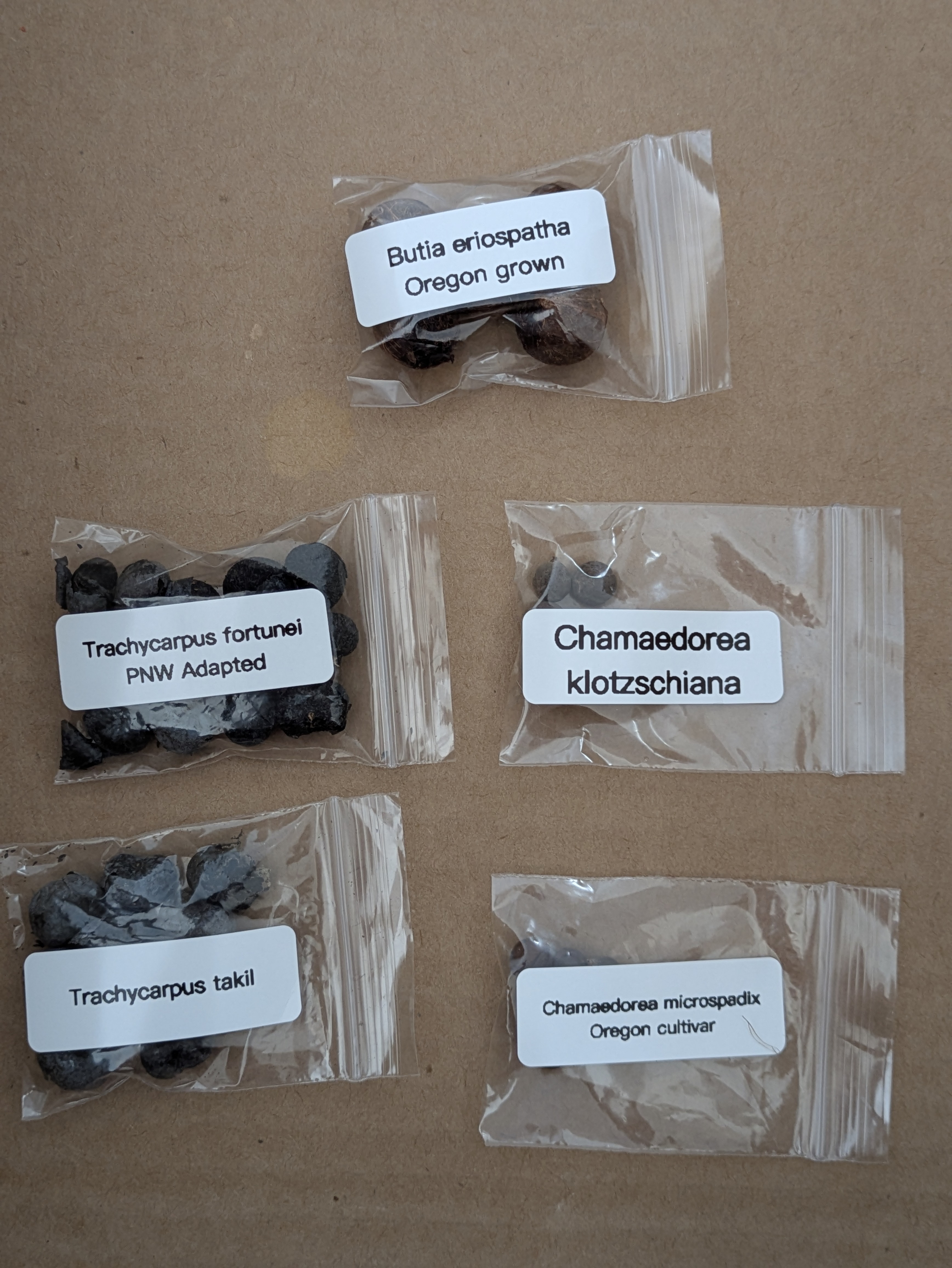
April 2 — Chamaedorea klotzschiana and C. microspadix sown shallowly in 50/50 perlite and coco coir.
April 4 — Trachycarpus fortunei, T. takil, and Butia eriospatha sown in same mix.
Current setup
- Mix: 50/50 perlite and coco coir
- Sowing depth: Shallow (seed half-buried or surface-sown)
- Pot size: 6” deep for Chamaedorea and Trachycarpus; deeper for Butia
- Bottom heat: heat mat, targeting 75–80°F
- Location: indoors
Next steps
- Watch for radicle emergence at the seed base (first sign of germination)
- Chamaedorea expected 4–8 weeks at 27–30°C; Trachycarpus similar at 27°C; Butia slower — 3–6 months
- Keep mix evenly moist but not waterlogged; do not let dry out
- Once 1–2 leaves have formed, move to individual pots with depth appropriate to root type
Research notes
Key points from sourced references:
- Soak seeds 48–72 hours before planting; viable seeds generally sink within 24 hours (Palm Society)
- Optimal germination temperature: 85–95°F (acceptable range 70–100°F) (UF/IFAS EP238)
- Some species have calcium oxalate crystals in the fruit pulp — use gloves when cleaning (UF/IFAS EP238)
- Transplant seedlings after 1–2 leaves have formed, preferably in warmer months; set soil line ~½” above stem base — too deep causes setbacks or death; shade at 50% for several weeks post-transplant (UF/IFAS CN010)
- Pot depth by root type:
- 6” deep — shallow/non-aggressive roots: Chamaedorea, Calamus, Coccothrinax, Dypsis, Licuala, Pinanga, Roystonea, Rhapis, Trachycarpus
- 8–10” deep — deep taproots: Archontophoenix, Bismarckia, Brahea, Caryota, Chambeyronia, Veitchia, Sabal (Jungle Music)
- When unsure, go deeper
Sources
- https://palms.org/a-practical-guide-to-germinating-palm-seeds/
- https://ask.ifas.ufl.edu/publication/EP238
- http://www.virtualherbarium.org/horticulture/palmseed.html
- https://extension.unr.edu/publication.aspx?PubID=3243
- https://www.junglemusic.net/palmadvice/palms-seed-germination.htm
- https://ask.ifas.ufl.edu/publication/CN010