Chamaedorea microspadix
Hardy Bamboo Palm
Arecaceae
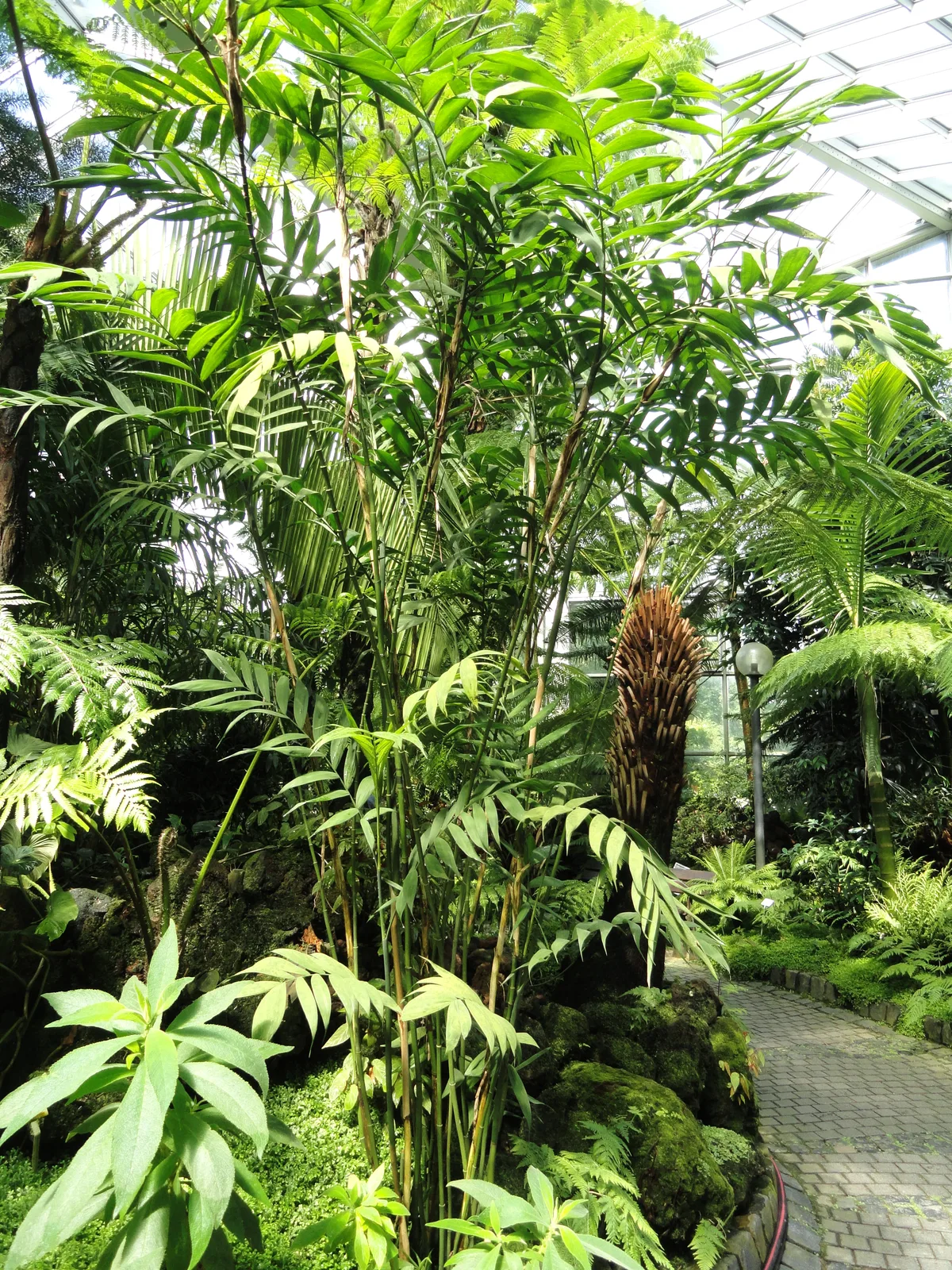
Chamaedorea — from the Greek for “dwarf/near the ground” and “a gift” — is a fitting name for this genus of graceful understory palms. A clustering, cane-forming palm from the forested understory of eastern Mexico, distributed across Veracruz, San Luis Potosí, Hidalgo, and Querétaro, where it often forms dense colonies in moist, shaded conditions. One of the hardiest Chamaedorea species, with cold tolerance well beyond most in its genus. According to palm botanist Donald Hodel (PalmArbor, 2022), the species withstands -2 to -4°C (25–28°F) without leaf damage and survives to around -7°C (20°F) with damage. The Oregon-grown lineage available from PacificNorthwestPalm is cold-selected, with the seller claiming survival to 10°F (-12.2°C). Both parents of the closely related hybrid C. × microcalis grow natively on calcareous substrate in northeastern Mexico, suggesting C. microspadix is more pH-flexible than typical humus-forest palms. Recipient of the Royal Horticultural Society’s Award of Garden Merit.
The bamboo palm name reflects both appearance and growth habit: multiple slender, jointed cane stems emerge from a shared root mass, each bearing graceful pinnate fronds. Internodal leaf scarring gives the stems a bamboo-like segmented look. The pinnae are notably sigmoid (curved), with 7–9 per side — a distinguishing trait from hybrids and related species. Outdoor specimens reach 8–10 ft tall with a 3–7 ft spread; container-grown plants typically stay 4–6 ft. The species is dioecious — separate male and female plants are required to set fruit. Female plants produce small creamy white flowers in summer (July–August), followed by showy red berries.
Care
Shade is a genuine requirement, not just a preference — direct sun bleaches and scorches the fronds quickly. Cloud forest species are adapted to low light and diffuse bright conditions. Indoors or under a shade structure, it performs well with moderate, consistent watering; allow the top inch of soil to dry slightly between waterings but avoid prolonged drought. High humidity benefits foliage quality; misting or grouping with other plants helps in dry indoor environments.
Fertilize lightly during the growing season with a dilute balanced fertilizer. Repot when roots begin circling the base, using a well-draining humus-rich mix. Cold-damaged fronds can be removed at the base; the rhizome and root system often survive temperatures that kill the canopy.
Conservation Status
Chamaedorea microspadix is listed as Least Concern on the IUCN Red List, with stable populations across its native Mexican range.
Zone 6b Notes
Experimental as a protected outdoor or patio container plant. The Oregon cultivar represents the cold-hardiest known lineage of this species, but zone 6b winters routinely exceed the safe threshold for unprotected exposure. Most viable as a container plant summered outdoors in a sheltered, shaded position and overwintered in a frost-free greenhouse or cool indoor space. Heavy mulching and wrapping may allow in-ground survival in a very protected microclimate (south-facing wall, deep mulch) but this remains unconfirmed at this site.
Propagation Notes
Seeds sourced from PacificNorthwestPalm (Damascus, Oregon) — Oregon cultivar, cold-selected. Sown 2026-03-31 in a perlite and coco coir germination mix with bottom heat via seedling mat. Clustering habit means established plants can also be divided.
Hybridization note: C. microspadix will spontaneously cross with C. radicalis if both are in flower nearby, producing the nothospecies Chamaedorea × microcalis (Hodel, 2022). Seeds from PacificNorthwestPalm originate in Oregon where C. radicalis is unlikely to be present, so the lineage should be true — but seedlings grown to maturity alongside C. radicalis could yield hybrids in subsequent generations.
Cover Image
Cover image: Chamaedorea microspadix at Palmengarten Frankfurt. Photo by Daderot, CC0, via Wikimedia Commons.
History
- 2026-03: Seeds acquired from PacificNorthwestPalm (Etsy). Described as “Cold Hardy Palm 10F — Oregon cultivar Seeds — Chamaedorea Microspadix Palm Tree — Shade tolerant — Clustering Palm — grows very well in pots.”
- 2026-03-31: Seeds soaked and sown in perlite/coco coir mix; seedling mat applied for bottom heat.