Akebia quinata
Chocolate Vine
Lardizabalaceae
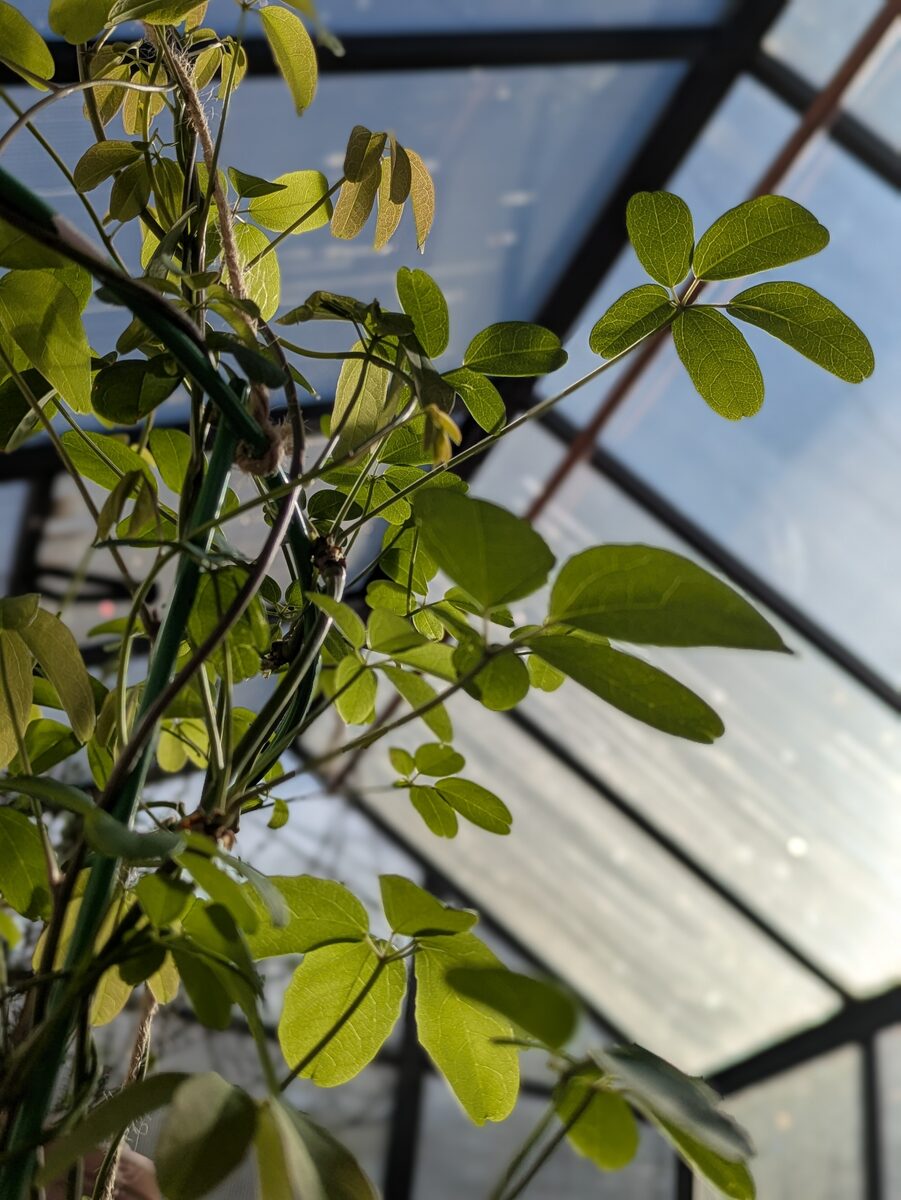
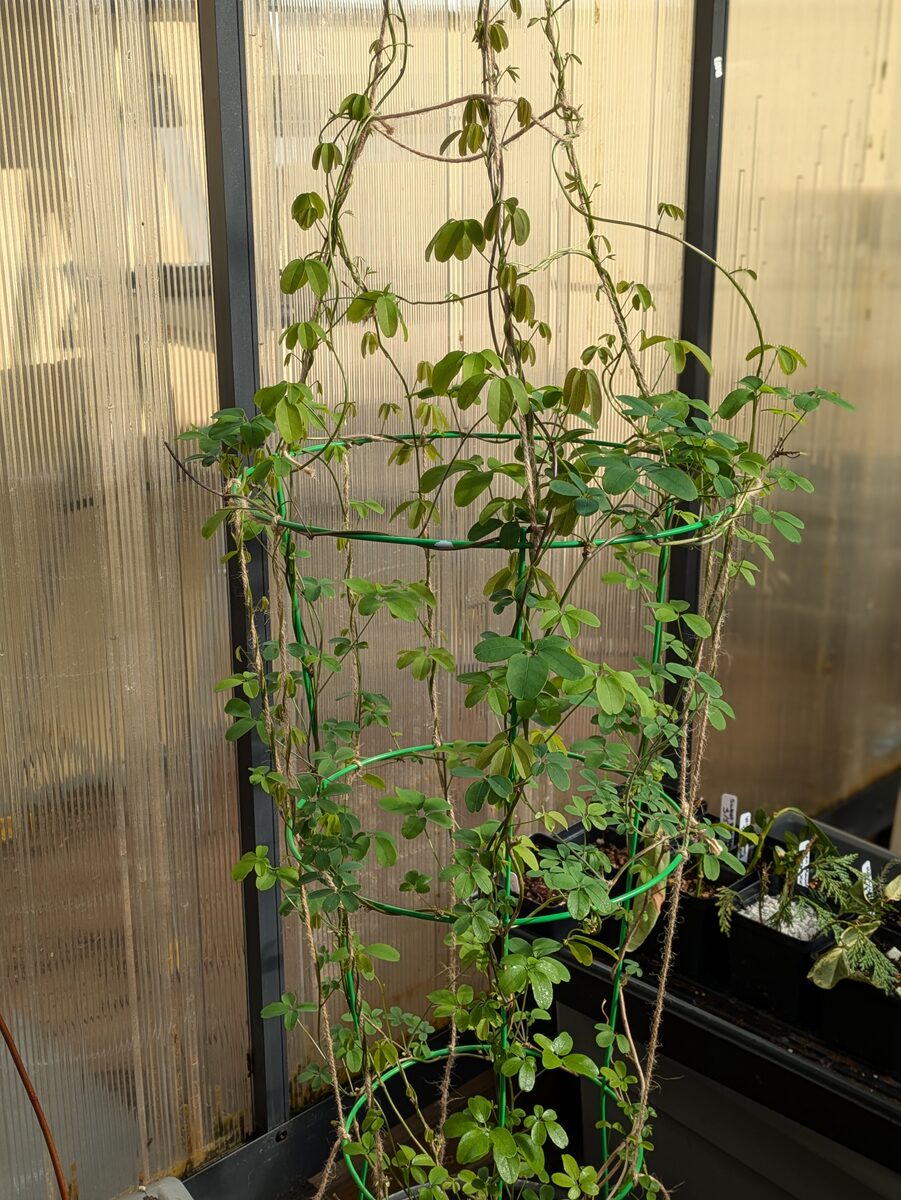
Arrived February 18 in good condition with several tendrils and a few leaves. Potted up on arrival and kept indoors for the first few weeks. New leaf growth came quickly and the plant began climbing. Flowered once indoors. Moved to an unheated greenhouse that dips close to freezing; growth has slowed but the plant is holding well. Currently staked with a tomato cage as a temporary support.
Foliage, Flowers, and Fruit
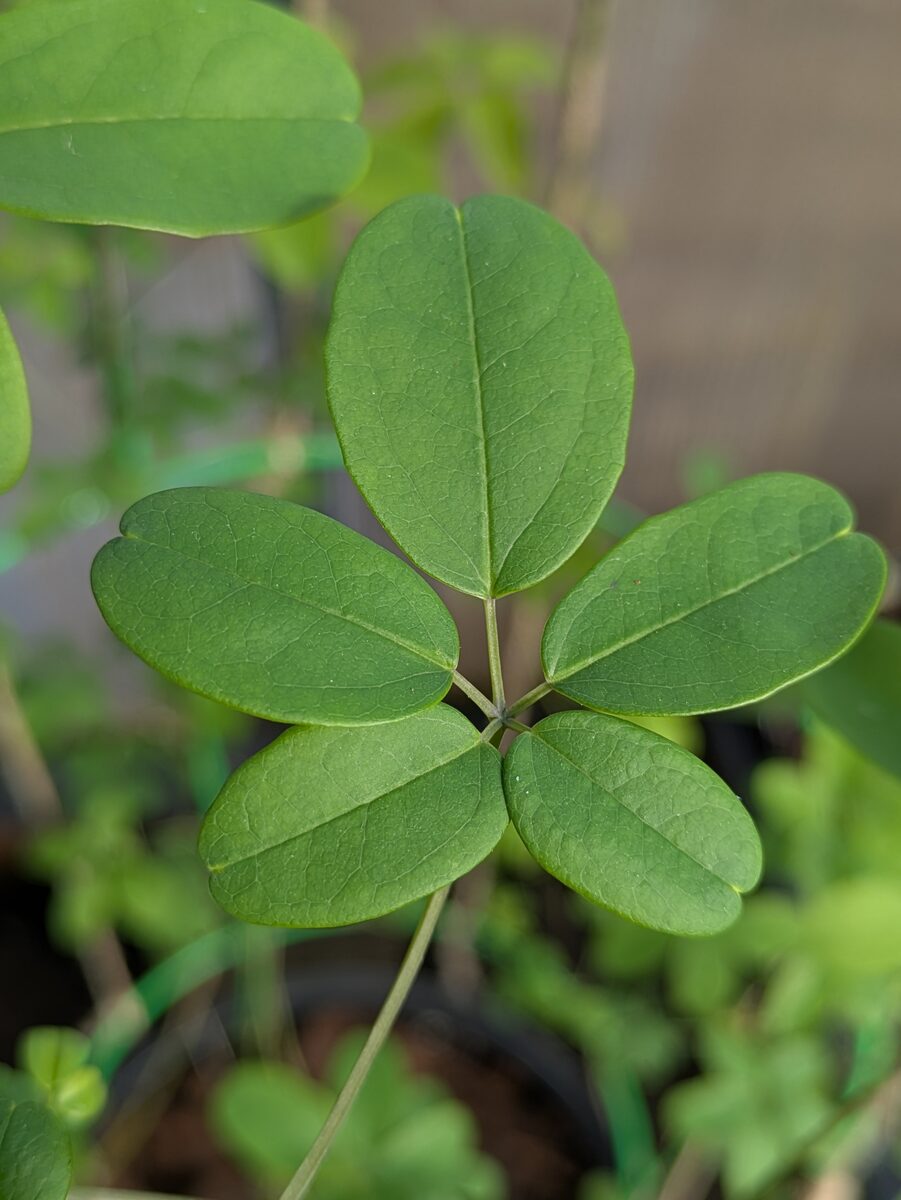
Leaves are palmately compound with five ovate leaflets, each 1–3 inches long, arranged alternately along pliable, twining stems. Bright blue-green above, glaucous beneath; foliage takes on a purple-bronze tint in cold weather. Semi-evergreen in mild winters, fully deciduous in colder zones.
Flowers emerge in early spring on old wood in pendulous racemes before the new leaves fully expand. Each raceme carries both sexes: one or two large female flowers (~1.5 inches across) toward the base, with smaller and more numerous male flowers above. Neither has true petals — the purple-maroon petal-like structures are sepals. The scent is variously described as chocolate, vanilla, nutmeg, or spicy-sweet; distinct and unusual.
Fruit are sausage-shaped purple pods, 3–4 inches long (up to 10cm), ripening in autumn and splitting open to reveal white, gelatinous flesh studded with numerous small black seeds. The flesh is edible fresh, with mild sweetness reminiscent of dragon fruit. In Japan the hollowed peel is fried and stuffed with minced meat or mushrooms. Fruiting in cultivation requires cross-pollination from a genetically distinct plant and a long, warm summer — uncommon in cool climates. Birds readily eat the fruit and disperse seeds.
Care
Tolerates full sun to deep shade and adapts to most reasonable soils — chalk, clay, loam, or sand — at acid, neutral, or alkaline pH. Drought-tolerant once established. Fast-growing; plants can reach 30–40 feet at maturity with a spread wider than 25 feet. Prune hard immediately after flowering in spring to control size and direct growth; vines are pliable and can be cut back severely without harm. In zone 6 it is reliably deciduous; re-leafs each spring from established roots without issue.
Two plants of different clones should be grown in proximity for fruit production. The vines are flexible enough to be worked into wreaths and basketry.
Cultivars
- ‘Alba’ — white-flowered form; otherwise identical to the species
- ‘Rosea’ — pale pink flowers
- ‘Shirobara’ — white flowers with deeper pink markings
- ‘Silver Bells’ — silvery-white flowers
- ‘Variegata’ — variegated foliage
- ‘Compacta’ — more restrained growth habit
Invasiveness
Listed as invasive by the North Carolina Invasive Plant Council. Spreads by root layering and by seed dispersed by birds. Can colonize forest edges and disturbed areas, crowding out native plants. In zone 6b, full invasive potential is moderated by cold winters — but it spreads readily in mild seasons and should be sited on an isolated trellis or structure with hard edges (mowing margins, pavement) to prevent ground-layering into adjacent beds. Monitor for rooting stems in contact with soil.
Sources: NC State Extension — Akebia quinata · UW Botanic Gardens — Akebia quinata ‘Alba’ · U of Arkansas Extension · RHS — Akebia quinata · Kew — Chocolate Vine