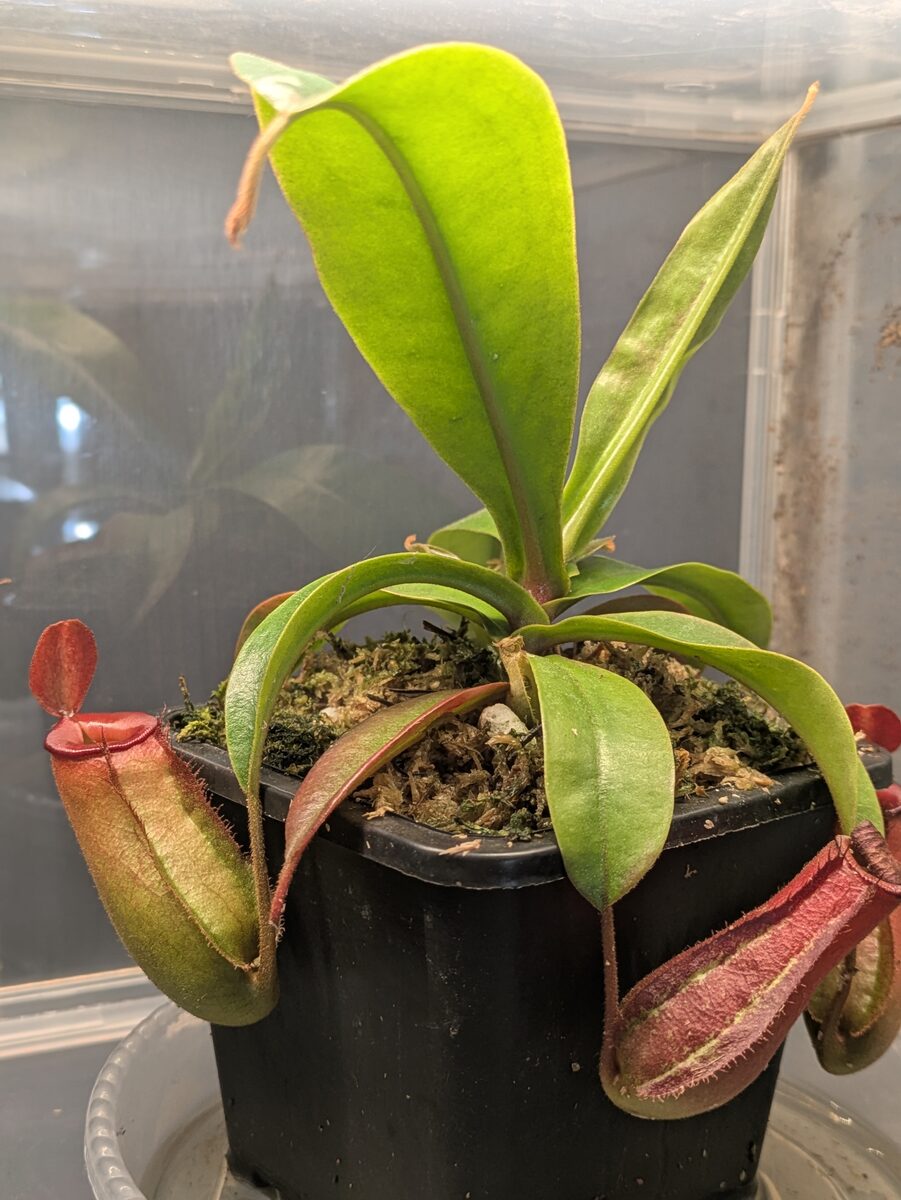
Nepenthes 'Bloody Mary'
Bloody Mary Pitcher Plant
Nepenthaceae
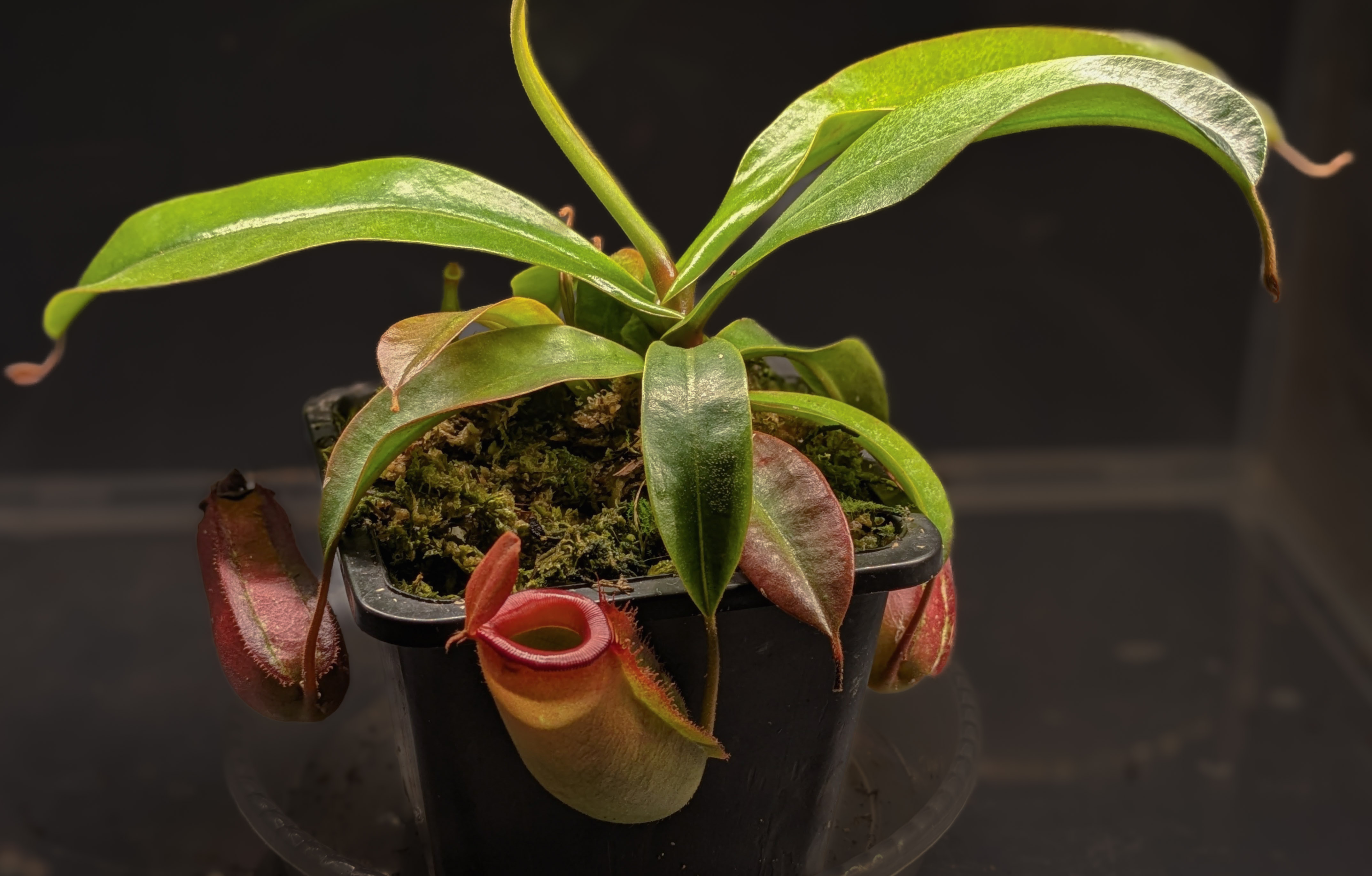
Kept in a humidity box. Had dried out; watered thoroughly, excess leaves removed, and returned to humidity enclosure. Light switched to a Barrina T5 grow light. A single Osmocote granule placed directly into each of two pitchers as a slow-release nutrient supplement — medium left unfertilized. Over the following weeks several large leaves emerged and the plant recovered quickly; currently growing well under the T5 in the humidity box.
Hybrid Parentage
‘Bloody Mary’ is a registered cultivar produced by Borneo Exotics as part of their Bio-Dome Program — a line of hybrids selected and acclimated specifically for indoor home growing. The cross is Nepenthes ampullaria (red form) × Nepenthes ventricosa. It is sometimes sold as ‘Lady Luck’ in certain markets; both names refer to the same clone.
The parentage explains the plant’s best traits: N. ventricosa contributes the elegant flared pitcher shape, the prominent ridged peristome, and strong tolerance for drier indoor conditions; N. ampullaria contributes the compact clustering growth habit, prolific basal pitcher production, and the deep red pigmentation carried through both parents.
Pitchers
Pitchers are compact, squat, and tubby — smaller than many Nepenthes species but produced prolifically and reliably. Color is uniform deep blood-red to crimson throughout the pitcher body, peristome, and lid, with nectar glands visible along the peristome ridges. The peristome is broad and distinctly ribbed, a strong ventricosa trait that gives the pitcher mouth an ornamental, almost sculptural quality. Lower pitchers cluster from the base in the manner of N. ampullaria, making a well-grown specimen dense and striking even without a climbing stem.
Pitcher fluid is the plant’s primary digestive medium — the plant secretes acidic enzymes into it to break down prey. Keep pitchers at least partially filled; they can be topped up with distilled or rainwater if they dry out.
Care
Light: Bright indirect light is ideal — roughly 10,000–20,000 lux. Morning direct sun is tolerated; intense afternoon sun bleaches the foliage and can reduce pitcher production. Under artificial light, a T5 or LED grow light at moderate distance for 12–14 hours works well.
Water: Use only distilled water, rainwater, or reverse-osmosis water. Minerals in tap water accumulate in the medium and cause root damage and foliage decline over time. Keep the medium consistently moist but not waterlogged. Tolerates having roots submerged in water if necessary.
Humidity: Prefers 60–80%. More forgiving than many Nepenthes — can adapt to 50%+ with adequate light. A humidity box, cloche, or enclosed terrarium maintains ideal levels. Misting is less effective than enclosure for sustained humidity.
Temperature: Daytime 70–85°F, nighttime 55–70°F. Tolerates a wider range (roughly 55–90°F) without serious harm. No dormancy period — maintain warmth year-round.
Feeding: Catches small insects naturally. Indoors, supplement every 3–4 weeks by placing one or two dried mealworms, small crickets, or a pinch of dried fish flakes directly into a pitcher. Do not feed more than one pitcher at a time, and never fertilize the growing medium — low-nutrient conditions are essential.
Medium and repotting: A 1:1 mix of long-fiber sphagnum moss and perlite works well. Pure sphagnum also works. Avoid any medium containing fertilizers, lime, or standard potting soil. Repot when the plant becomes rootbound or the medium begins to break down and compact.
Growth Habit
Extremely fast-growing relative to most Nepenthes. Produces a compact rosette with short internodal distances, making it well-suited to terrariums and windowsills without quickly outgrowing the space. Basal offshoots develop freely, eventually forming a clustering colony. Pitcher production is reliable even in moderately low light, making it a strong performer compared to more demanding species.
Sources: BugBitingPlants — Nepenthes Bloody Mary · Nepenthes Diary — Lady Luck · Tom’s Carnivores — Tropical Pitcher Plants · ICPS — Nepenthes Care
History
Acquired June 2025 from Orange Lake Nursery, alongside a Sarracenia purpurea. Kept outside at times but primarily maintained as a houseplant indoors.